
Simple, Exponential, and Weighted Moving Averages are the most familiar options, but they are only part of the Moving Average family. Traders can also use averages designed to react faster to price changes, create smoother trend lines, account for trading volume, or adapt to changing market conditions.
They all have a similar purpose: making price direction easier to read. The main difference is how the average is calculated and how quickly it responds when the market moves.
Comparing Different Moving Averages
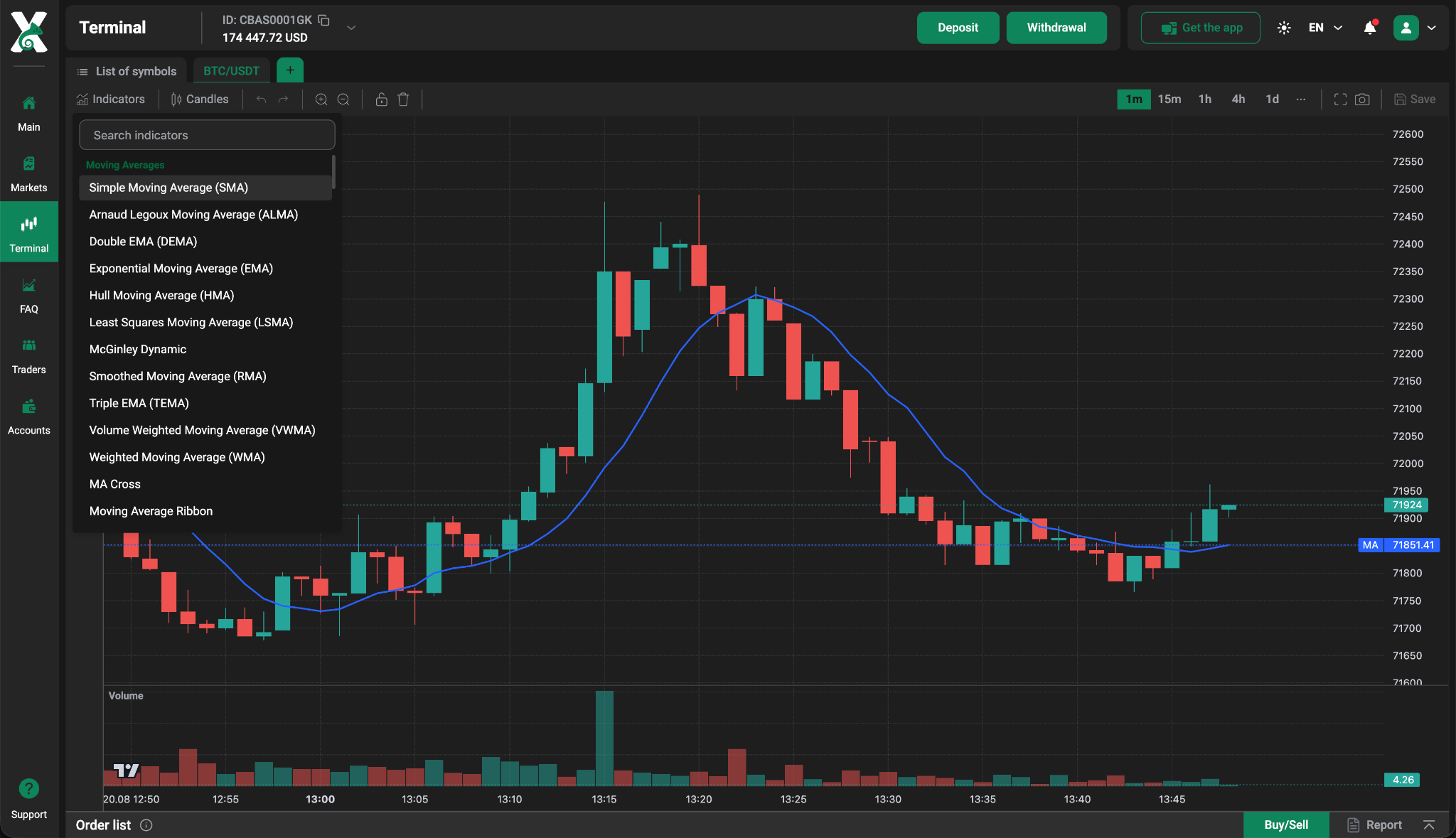
Some Moving Averages focus on reducing lag, while others prioritize smoothness or use additional market data in their calculations. This can change how closely the line follows the current price and how strongly it reacts to short-term fluctuations.
|
Moving Average |
How It Works |
Main Characteristic |
|
Double Exponential Moving Average |
Combines exponential calculations to reduce the delay of a traditional average |
Faster response to price changes |
|
Triple Exponential Moving Average |
Uses multiple exponential calculations to further reduce lag |
Responsive while maintaining a smoother line |
|
Hull Moving Average |
Combines weighted calculations with additional smoothing |
Designed to balance speed and smoothness |
|
Arnaud Legoux Moving Average |
Applies weights across the selected period to smooth price data |
Balances responsiveness and noise reduction |
|
Least Squares Moving Average |
Uses linear regression to calculate the line |
Focuses on the direction of the price trend |
|
Running Moving Average |
Applies additional smoothing to previous values |
Slower and less sensitive to short-term fluctuations |
|
Volume Weighted Moving Average |
Includes trading volume when weighting prices |
Gives more influence to periods with higher volume |
|
McGinley Dynamic |
Adjusts automatically as the speed of price movement changes |
Adapts to changing market conditions |
These differences do not make one Moving Average universally better than another. A faster average may follow a changing market more closely but can also react to movements that later prove insignificant. A smoother average filters more of this noise but may take longer to reflect a change in direction.
Using Multiple Moving Averages
Moving Averages do not have to be used individually. Traders can place several averages on the same chart to compare price trends over different periods.
MA Cross focuses on the relationship between two Moving Averages. It makes it easier to see when the faster and slower averages cross, which can help traders identify possible changes in trend direction.
A Moving Average Ribbon expands this idea by displaying several Moving Averages at once. Instead of following a single line, traders can observe how a group of averages behaves as the market changes. The distance and relationship between the lines can provide additional context about the direction and development of a trend.
Which Moving Average Should You Use?
The choice depends on what a trader wants to see on the chart. A more responsive Moving Average may be useful when following faster price movements, while a smoother one can make the broader trend easier to read. Volume-based or adaptive averages add another perspective by considering factors beyond price alone or adjusting their behavior as the market changes.
Rather than looking for one “best” Moving Average, traders can compare different types directly on the chart and see how they behave across instruments, timeframes, and market conditions.